Q&A: Tony Capra on AI, Ancient DNA, and the Future of Genetics
Q&A: Tony Capra on AI, Ancient DNA, and the Future of Genetics
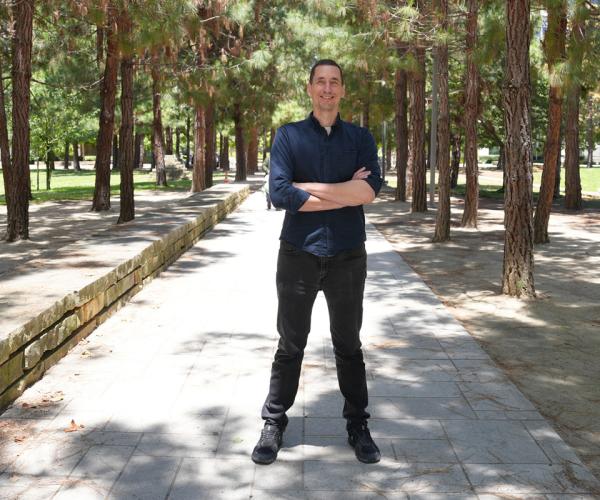
Tony Capra, PhD, first came to UCSF as a postdoctoral fellow, where he learned to apply computational methods to genetics and human evolution. Now a professor in the UCSF School of Pharmacy's Department of Bioengineering and Therapeutic Sciences, Capra develops computational and AI methods to better understand genetic variation, rare disease, and the biology that makes us human.

Q: Your lab studies everything from human evolution to rare disease. What's the common thread?
A: My lab is focused on interpreting DNA differences between people and between different species. We've had whole genome sequences for humans for more than 20 years, and we still don't fully understand what most of our genome does.
If we identify someone with a disease that we think has a genetic cause, we can find thousands of places where their genome differs from other people. We don't know which of those differences, if any, matters. To me, that's a fascinating — and really frustrating — problem.
In the context of evolution, we know what the differences are between humans and our closest relatives, but we don't know how to interpret them into a story about what makes us human. I believe that AI approaches are very promising for making progress on this problem, so my lab develops computational methods to interpret genetic variation.
Q: What have you learned from studying ancient DNA?
A: One of the biggest surprises we found is that events in the recent past still have effects on us today.
We now know, because researchers were recently able to sequence DNA from fossils, that modern humans have Neanderthal DNA in their genomes. We used large biobanks linking people's DNA with electronic health records to study how Neanderthal DNA influences human health. Most Neanderthal DNA wasn't helpful, but there were a few places where it seemed to be beneficial.
A common misunderstanding is that there's one Neanderthal gene that explains a trait or disease. It's not actually so simple. They contribute a small amount of variation to the wider landscape of genetic differences present across human groups. We can't blame Neanderthals for any of our negative traits, but there is a legacy of them that's still inside us today.
Q: How is AI changing genetics research?
A: So much of our understanding of Neanderthals and what we're trying to do now is based on AI. We'll probably never be able to resurrect a Neanderthal, but powerful new algorithms that take DNA sequence as input and predict traits as output are enabling us to do this in the computer.
It's a similar story on the clinical side. Instead of comparing Neanderthal DNA versus human DNA, we have healthy humans versus someone with disease. We can use the computer to help us test thousands — or even millions — of possible genetic differences and identify the hypotheses about the causes of disease that are most promising to test experimentally.
Q: What makes identifying the genetic cause of a rare disease so challenging?
A: Seventy percent of cases of rare diseases are still unsolved. We don't know what genetic variants are causing their disease, even though we've sequenced their whole genomes and had world experts analyzing them.
Each one of us is walking around with thousands of rare genetic variants. Most don't cause debilitating disease. We're trying to find that needle in the haystack.
Unfortunately, many diseases don’t follow the simple model of one causal genetic mutation. We build computational tools that rapidly screen much more complex hypotheses so we can focus our limited resources on the experiments most likely to yield useful information.
Q: What discovery from your lab are you most excited about right now?
A: One of our most exciting recent discoveries is that there are more than 500 genes that cause disease where, if we can figure out how to inactivate the copy that causes disease, the other copy of that gene will likely be able to compensate and maintain or restore health.
There were known examples before, but the scale and opportunity — the number of genes in our genome that have that ability to compensate — is super exciting to me. We recently identified more than 150 genes where there are real people with disease-causing variants who could potentially benefit from this kind of approach.
Q: As Co-Director of the Bioinformatics PhD Program, what advice would you give students interested in pursuing scientific research?
A: I believe very strongly in basic science research driven by fundamental human curiosity. This often can lead to the biggest, most surprising and most practical breakthroughs.
I transitioned from computer science to working in genetics and evolution because I was fascinated by the possibility of understanding, at the genetic level, what makes us human. I wasn't doing that because I thought one day it would help me understand the causes of rare disease. But it did, and it is.
Everything is so interconnected that if there's something you're curious about and really want to understand, it's worth following that interest.