Q&A with Rhea Misra, PharmD ’26: From “Side Quests” to Pharmaceutical Marketing
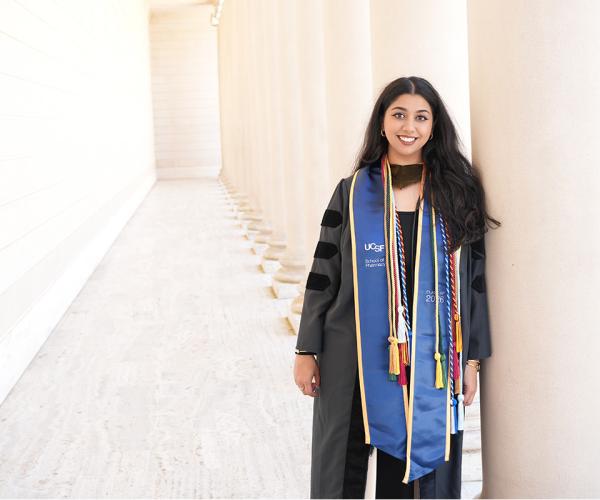
When Rhea Misra, PharmD ’26, began pharmacy school, she had a plan: choose one path and follow it. Three years later, she’s beginning her career in pharmaceutical marketing, as a postdoctoral fellow in U.S. Marketing at Daiichi Sankyo, supporting I-DXd in the lung cancer therapeutic area, in affiliation with the Rutgers Pharmaceutical Industry Fellowship (RPIF) Program.
Along the way, Misra explored clinical care, leadership, artificial intelligence, and communications — including a work-study position with the UCSF School of Pharmacy communications team. Those experiences helped her discover that a PharmD can be much more than preparation for a single career path.
Here, Misra reflects on the experiences that shaped her journey and what she hopes to do next.
You recently graduated from UCSF and are beginning a new chapter at Daiichi Sankyo. What will you be doing?
I feel like this post-graduation chapter has been a culmination of all my experiences throughout pharmacy school.
I’m joining Daiichi Sankyo as a U.S. Marketing fellow through the RPIF program. I’ll be working on the I-DXd team, and it’s going to be exciting because I get to work cross-functionally and gain exposure to different perspectives and areas of expertise.
I’ll be learning alongside colleagues across marketing, medical, legal, and regulatory, while also getting the chance to work with groups I never expected to be exposed to, like agency partners. I’ve already enjoyed seeing how all of these functions come together and contribute to the work in their own way.
Coming from the UCSF School of Pharmacy, we really learn how the medications work from a clinical perspective. But now I’m seeing the other, complete opposite side of health care. It’s about how we’re bringing all the evidence. It’s about collaboration with these different teams, and it’s about strategy to support the patients on the other side.
I’m using the foundation that I built as a pharmacist, and applying it in a different environment.
How has your idea of what a pharmacist can do changed?
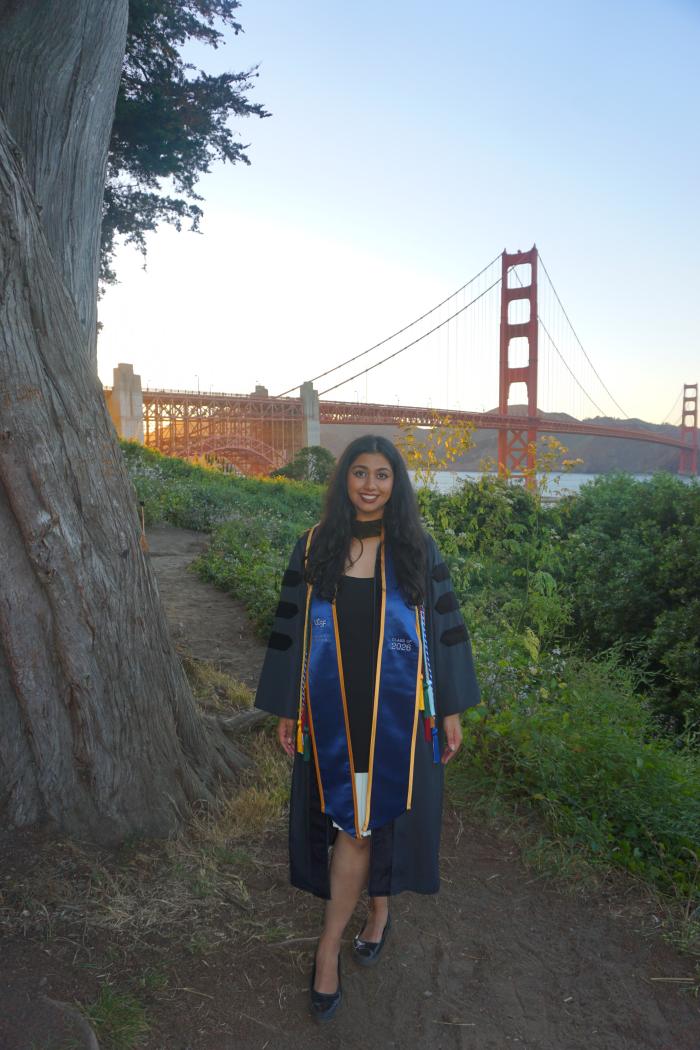
One of the big things that I already started realizing during pharmacy school was the different career paths. I’ve realized now how versatile my PharmD can be.
Through UCSF, I was able to do all the clinical care, try out communications, and participate in different leadership opportunities. Now, in the pharmaceutical industry, the experiences are very different, but our purpose is still the same.
I’m still using my critical thinking, collaboration, and patient care skills, but I think what’s changed is how I view my degree. It’s not just one career path, it’s a foundation for me to create impacts in different career paths.
Your experiences at UCSF included clinical rotations, leadership, communications, and AI. How did those experiences come together?
I don’t think it was necessarily one class, rotation, or organization. I think the great thing about UCSF was every experience built on the one before.
When I was in my clinical rotations, I really learned why our patient care is at the heart of everything that we do. And then with some of the leadership experiences, I learned how to work in administrative and diverse teams.
Working with the communications team was really special because it gave me an opportunity to hear stories from other students, faculty, and alumni. I got to see people who are doing research, people working in AI, people starting new initiatives, or finding their own paths.
That taught me that there isn’t one right way to build a meaningful pharmacy career. When you see everyone’s different story, I feel like those inspire other people to pursue opportunities that they might not have thought of for themselves.
I also had mentors throughout my rotational year and throughout my time at UCSF who encouraged me to explore opportunities that didn’t fit the traditional path. Instead of asking, “What kind of clinical pharmacist do you want to be?” they just asked me, “What do I enjoy? What kind of impact do I want to have?”
That helped change my perspective and gave me more confidence to pursue industry.
What attracted you specifically to pharmaceutical marketing?
I like that it’s a combination of all the skills I’ve worked on because you’re working in a very collaborative environment. It bridges that gap between science and communication, because you can have an amazing drug, you can have an amazing team, but if you can’t bring it to the patients, then it doesn’t serve its purpose.
I like that marketing bridges that gap between the patient and the medication. The main thing to me is that bridge — being able to take all this complex information, this complex data, this drug, everything that we have on our side, and then actually bring it to the patient and explain it. Or bring it to the health care provider and explain to them why it’s beneficial for their patients.
You’ve worked with AI and are entering an increasingly technology-driven industry. Where do you see AI fitting into the future of health care?
Having worked with InPharmD where I worked on their AI team, I saw how AI is an incredibly valuable tool for improving efficiency and analyzing huge amounts of data and information that would have traditionally taken us months to get through. Technology in general has always played a big role in how we enhance our work.
But in the same breath, I don’t see AI replacing parts of health care that depend on human and clinical judgment. It’s not just about having the information and spitting something out. You still have to ask the right questions. You have to understand the context of it.
At the end of the day, you, as a provider or a pharmacist or physician or a nurse, still have to make ethical, logical decisions. And health care is super personal.
Patients aren’t just data sets. Important decisions have to include empathy, trust ,and nuance. Can technology alone give that to us? No.