Shape Shifting Gel Enables More Precise 3D Printing of Lab-Grown Organs
Shape Shifting Gel Enables More Precise 3D Printing of Lab-Grown Organs
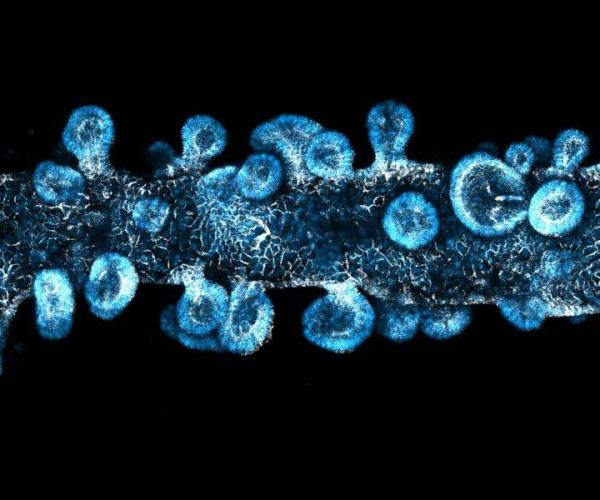
UCSF scientists, including School of Pharmacy professor Zev Gartner, PhD, have developed a new “shape-shifting” gel that is advancing efforts to grow organs in laboratories by enabling researchers to 3D-print living cells that develop into complex tissue structures.

The breakthrough, reported in a new study in Nature Materials on March 10, helps researchers produce better and more consistent organoids.
Organoids are miniature organ-like structures used to study disease and test treatments, and are increasingly important in biomedical research because they can mimic many features of human organs. However, they often grow unpredictably, making it difficult for scientists to reproduce experiments. The UCSF team sought to overcome this challenge by designing a material that better recreates the supportive environment cells experience inside the body.
The new gel combines microscopic particles of alginate, a carbohydrate derived from algae, with Matrigel, a common laboratory material used to grow organoids. Together, the mixture supports stem cells that were printed in lines, while allowing the organoids to expand and organize more naturally over time as the cells grew.
Read the full story at the UCSF News Center.