"Nontraditional" PharmD Students Answer the Call to Patient-Centered Care
Every year, the UCSF School of Pharmacy welcomes a new class of learners whose paths into the profession reflect the changing landscape of pharmacy. Among the Class of 2028 are a handful of "nontraditional" students who returned to school to pursue a PharmD degree after established careers.
These students bring hard-earned perspective, deep technical expertise, and a lived understanding of what it means to recommit to their purpose.
Many navigated the upheaval of the COVID-19 pandemic as working professionals and gained a renewed sense of patient-centered care, with a shared goal of contributing more directly to health and patient care while helping to amplify the vital role of the pharmacist.
Meet a few of these students, who collectively refer to themselves as “The Pharma Ladies.”
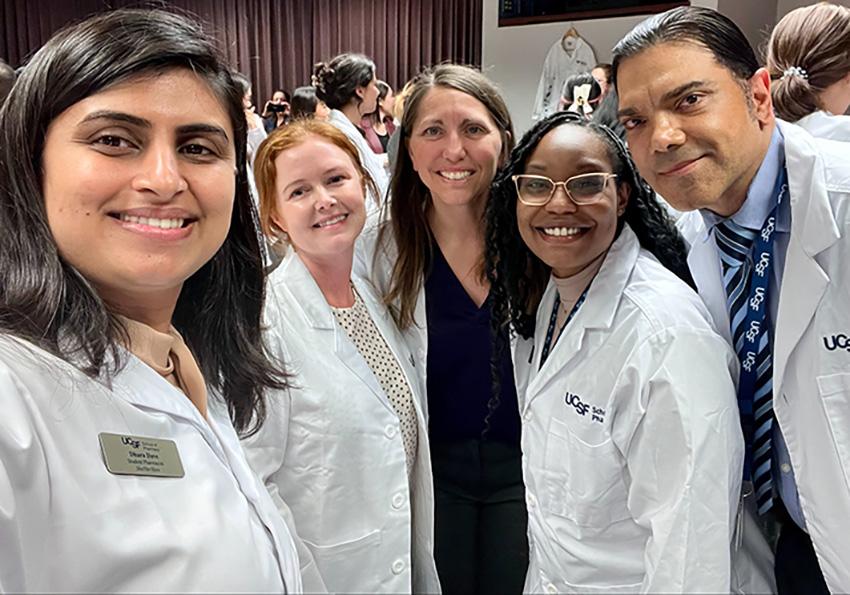
Dave, Hanna, Ahsan, and Watkins-Griffin and along with fellow nontraditional learner Joel Daniel Ponce at the Class of 2028 White Coat Ceremony.
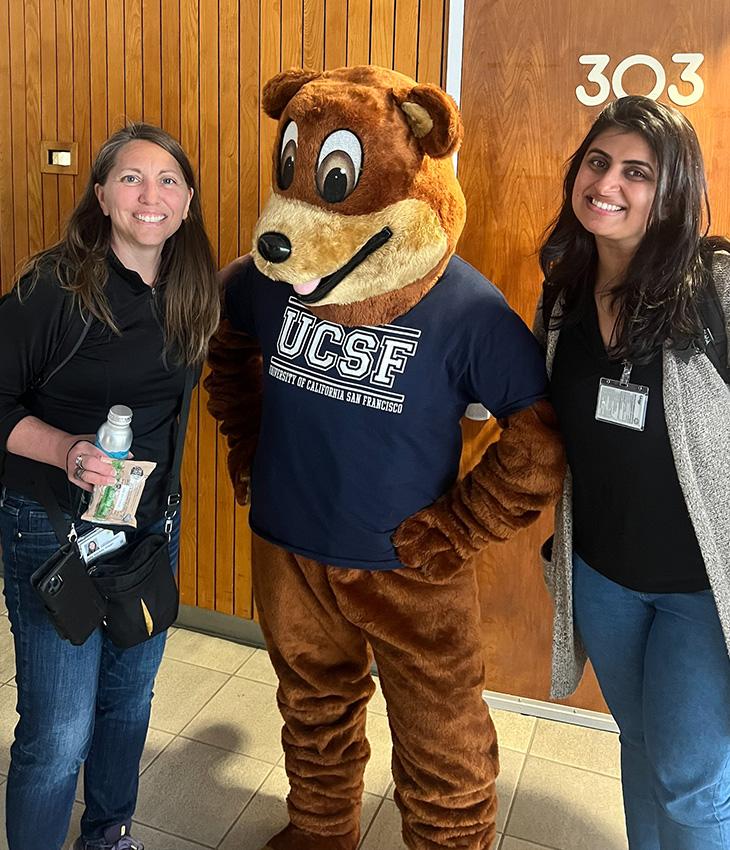
Ahsan and Dave with UCSF mascot.

Watkins-Griffin, Dave and Ahsan.
Jayd Hanna: Reframing a scientific career toward patient impact
After studying biology during her undergraduate years in South Carolina and specializing in molecular biology while earning her master's degree from Manchester University, Jayd Hanna built a career in pharmaceutical innovation.

For 15 years, she worked in early drug discovery on large-molecule therapeutics, including monoclonal antibodies, first at Eli Lilly and Company and then at Tentarix Biotherapeutics. The work was intellectually challenging and rewarding, Hanna said, but during the COVID-19 pandemic, her role expanded in an unexpected way.
Her lab was working on a COVID-19 therapeutic that received emergency use authorization, and she volunteered for Lilly’s community outreach to help screen patients for COVID tests. For the first time, Hanna spoke directly with the people her work was impacting.
“There were very limited tests, so you would have to talk patients through their medical history. Some had family members that had already passed away from COVID,” she said. “As hard as it was to hear these stories, it drove me to work harder to help people, because I could see the difference it was making.”
The experience clarified her sense of purpose. "A switch flipped, and I realized I need that human interaction,” she said. “I love therapeutics, but in the setting that I was working in, it could be 10 or 15 years before your drug goes to market to help someone.”
Hanna said she had moments of doubt about going back to school, which required juggling coursework alongside full-time work, but that her love of learning was reignited.
“From having worked on monoclonal antibodies and then multispecific antibodies at a startup, I know that drugs are just getting more and more intricate. In the future, it's going to be impossible for doctors to keep up with medications. There will be a need for experts that understand medications on a molecular level,” Hanna said. “The role of a clinical pharmacist is going to continue to expand, and I want to be a part of that.”
“For years, I went back and forth, wondering if going back to school was really an appropriate thing to do, because I was in a good career with a lot to be thankful for,” Hanna added. “I realized that when you really have a drive to do something, there’s no such thing as too late.”
Dhara Dave: Third time pharmacist’s the charm
For Dhara Dave, pharmacy is a career she has returned to multiple times and in multiple countries. Born and raised in India, she earned her bachelor’s degree in pharmacy and later a master’s degree in medical devices, driven by an early fascination with how medicines and technology improve lives.
After immigrating to Canada in 2015, she completed multiple licensing exams while working her way up from being a pharmacy assistant, gaining experience in community pharmacy and pharmacy management before relocating to the United States in 2021 with her husband and young son. Unable to practice clinically without certifying anew, Dhara joined Stanford University as a research scholar, working in peripheral nerve regeneration and drug development. The experience reinforced her interest in research, but also clarified what she missed most.
“I love pharmacy, especially talking with patients. It's like detective work, and I have loved detective stories since childhood,” Dave said. “It’s like solving a case therapeutically, which propels me to learn more and go deeper to find out exactly what’s going on.”

In her third time at pharmacy school, Dhara has found a PharmD program that aligns with both her clinical experience and research ambitions. She hopes to take advantage of the UCSF School of Pharmacy's PharmD-PhD Program to integrate her interest in tissue engineering with her ongoing studies.
“I'm learning so many new things here at UCSF because so many therapy decisions are based on the research that is happening here,” she said. “Having access to so many clinical trials gives you clarity when you have so many options for the patient. It helps me tailor my approach and give more precise medication based on the patient scenario.”
Dave said her journey of almost two decades learning and practicing pharmacy has had challenges, including adapting to new countries and balancing school with parenting along with a long daily commute. Nevertheless, she feels that landing at UCSF was “meant to be.”
“Everything came together at UCSF, which is known for both research excellence and for pharmacy,” Dave said. “My son and I are both going to school at the same time, and it has made me realize there’s no age limit for learning.”
Julie Mackey Ahsan: Survival and purpose
Julie Mackey Ahsan arrived at the UCSF School of Pharmacy with decades of experience in clinical research and biotech, along with a deeply personal reason for returning to school. As a survivor of breast cancer, she is driven by a desire to help develop safer, more effective therapies, particularly in oncology.
“Working in an environment that placed a high value on higher education and training, I felt really inspired by pharmacists working in various different roles in the industry setting to earn a doctoral degree. It demonstrated the versatility of the PharmD degree,” Mackey Ahsan said. “Plus, I already had a strong desire to contribute as much as possible to patients with unmet medical needs.”
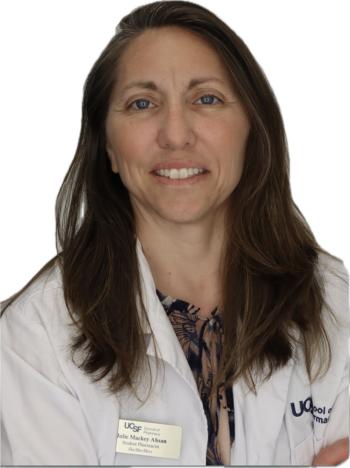
Like Dave, Mackey Ahsan balances pharmacy school with parenting. Her days begin early, getting herself and her first-grade daughter ready for school before heading to class.
Her advice to learners considering a mid-career return to the classroom? “Just do it! There’s never a good time to go back,” Mackey Ahsan said. “My husband and I have taken turns. I worked while he completed his nursing degree and now it’s my turn.”
After years supporting drug development and research, including as a clinical trials manager at Gilead Sciences and most recently as a clinical scientist director at Kura Oncology, she chose UCSF’s PharmD program for its global reputation.
“UCSF is a world-renowned institution on the cutting edge of research and innovation, and a leader in pharmacy education,” she said. “There are so many discoveries that have come out of UCSF. You’re learning from the best, and coming out poised to make a real contribution to the scientific and medical community.”
Jasmine Watkins-Griffin: Rediscovering a calling
Jasmine Watkins-Griffin thought she wanted to become a medical doctor while studying biology as an undergraduate. She fell in love with chemistry and began gravitating toward pharmacology, working as a pharmacy technician before — and again after — launching a successful career as a chemical analyst and chemical engineer.

She put pharmacy on the back burner while taking on leadership roles and briefly experimenting with a role in software, but the pandemic, she said, was an “eye-opener” that pulled her back toward pharmacy.
"What sustained me during the pandemic was helping our sales force and our customers be more aware of the COVID-19 virus and how to use our industrial cleaning products to kill the virus on hard, non-porous surfaces,” Watkins-Griffin said. “The pandemic made me realize I love helping people.”
Watkins-Griffin recertified as a pharmacy technician and took classes that put her on track to apply to pharmacy school. Looking back, she realized that she became the unofficial pharmacist in her family when she helped to streamline the long list of medications her grandmother was taking and advocated for conversations with her grandmother’s doctors. Her family leaned on her scientific knowledge and later revealed to Watkins-Griffin that they believe her efforts extended her grandmother’s life when she recovered from a coma.
“I didn’t know they felt that way. I just wanted to help,” she said. “But it made me realize this is where I’m meant to be.”
In 2024, she decided to pursue the path she’d been orbiting since 2011. She retook prerequisites, prepared her application to pharmacy school, and followed her passion to the San Francisco Bay Area from her native Georgia. She’s drawn to cardiology, motivated by her father’s cardiac history, and recently was surprised to discover an interest in pediatrics as she is preparing for her internship at UCSF Benioff Children’s Hospital.
“I wanted to learn from the best, and UCSF challenges me every day,” Watkins-Griffin said. “Pharmacy is a needed, beautiful profession, something that a lot of folks take for granted. I know that it's going to take the next wave of pharmacists to push it toward where it really needs to be, and I'm happy to be a part of the ride.”